EHR Bridge Design Specification
Table of Contents
- System Overview
- System Architecture
- Component Specifications
- Data Flow Patterns
- Interface Definitions
- Design Patterns
- Implementation Guidelines
System Overview
The EHR Integration System is a NestJS-based application designed to provide a flexible, extensible platform for integrating with various Electronic Health Record (EHR) systems. The system follows a layered architecture with clear separation of concerns, implementing abstract classes and interfaces to ensure modularity and testability.
Key Features
- Pluggable Architecture: Support for multiple EHR systems through adapter pattern
- Multiple Communication Protocols: REST and Bot/WebSocket client support
- Bidirectional Data Conversion: Seamless transformation between EHR and internal data types
- Database Integration: Context-aware data conversion with database lookups
- Type Safety: Strongly typed interfaces throughout the system
Architecture Principles
- Separation of Concerns: Clear boundaries between layers and components
- Interface-Driven Design: All interactions through well-defined interfaces
- Abstract Implementation: All components built as abstract classes for extensibility
- Dependency Injection: Loose coupling through NestJS DI container
System Architecture
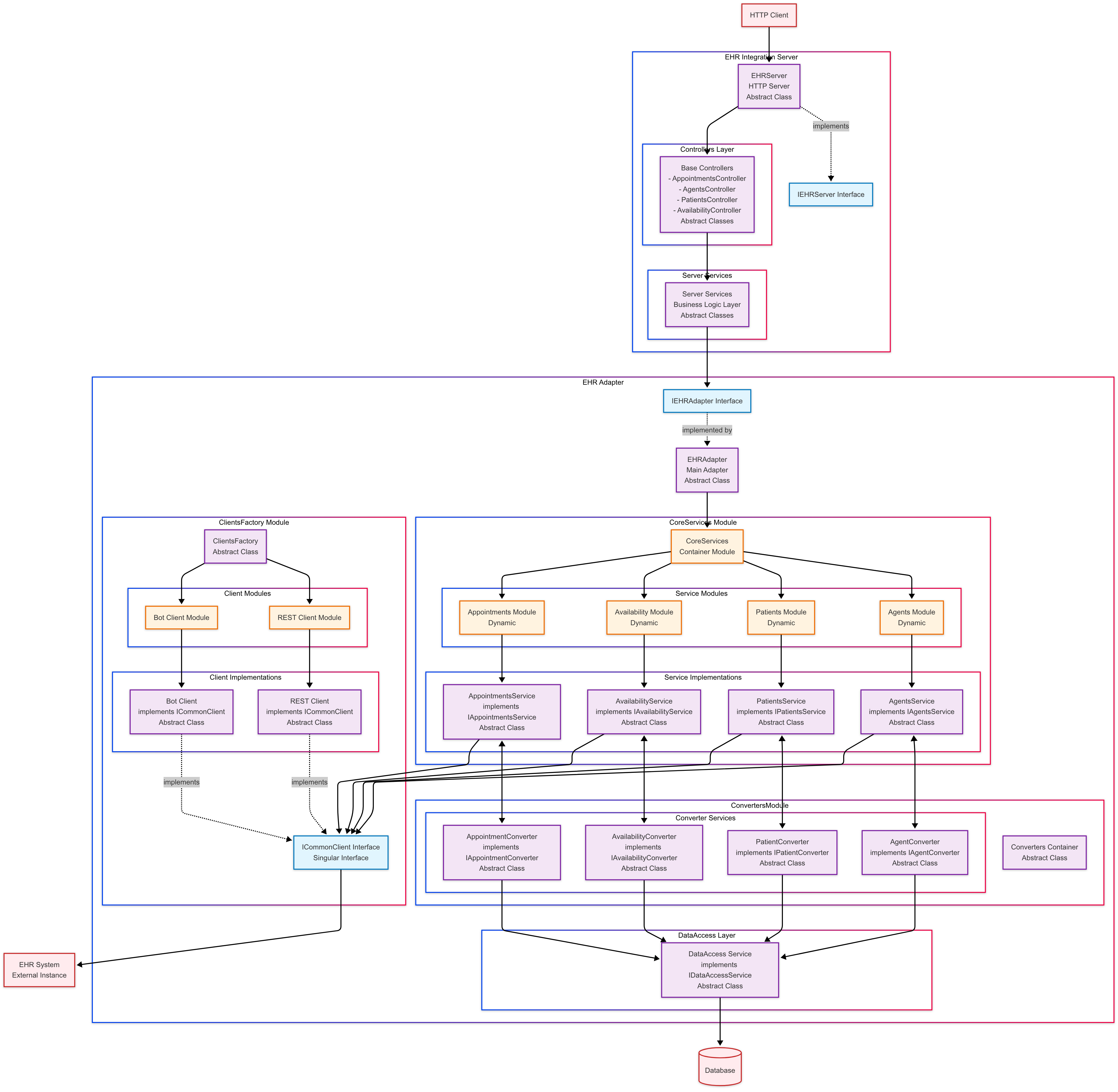
The system is composed of two main layers that work together to provide comprehensive EHR integration capabilities:
1. EHR Integration Server Layer
Purpose: The HTTP server layer that exposes REST APIs and handles client requests with full request/response lifecycle management.
Key Components:
- EHRServer (Abstract Class)
- Base Controllers (Abstract Classes)
- Server Services (Abstract Classes)
2. EHR Adapter Layer
Purpose: The core integration layer that communicates with EHR systems and handles data transformation between different data formats.
Key Components:
- EhrAdapter (Abstract Class)
- CoreServices Module
- ClientsFactory Module
- ConvertersModule
- DataAccessServiceLayer
System Design Diagram:
Component Specifications
EHR Integration Server
EHRServer
Purpose: Main HTTP server implementation that serves as the entry point for all client interactions.
Implements: IEhrServer interface
Key Responsibilities:
- HTTP request handling and routing
- Integration with EHR Adapter through well-defined interfaces
- Global error handling and middleware management
- Request/response logging and monitoring
- Security enforcement (authentication, authorization)
Base Controllers
1. AppointmentsController
Purpose: Handles all appointment-related HTTP endpoints including creation, updates, retrieval, and cancellation operations.
Key Endpoints:
POST /appointment/customer- Create new appointmentGET /appointment- Retrieve appointments with filteringPUT /appointment/customer/:id/cancel- Cancel appointmentsPOST /appointment/:id/reschedule- Reschedule appointments
Validation: Input validation for all appointment data including date/time constraints, agent availability, and patient information.
2. AgentsController
Purpose: Manages agent-related operations including agent lookup and availability checking.
Key Endpoints:
GET /agents- List agents with filtering capabilitiesGET /agents/:id- Get specific agent detailsGET /agents/:id/availability- Check agent availability
Server Services
Purpose: Business logic layer for server operations that coordinates between controllers and the EHR adapter.
Key Responsibilities:
- Request processing and business rule enforcement
- Data validation and sanitization
- Coordination with EHR Adapter through interfaces
- Response preparation and formatting
- Error handling and recovery
- Business logic caching and optimization
EHR Adapter
EhrAdapter (Abstract Class)
Purpose: Main adapter implementation that serves as the integration hub between the server layer and EHR systems.
Implements: IEhrAdapter interface
Key Responsibilities:
- Coordinating CoreServices operations
- Managing service lifecycle and dependencies
- Providing unified interface to server layer
- Abstracting EHR-specific implementation details
- Configuration management for EHR connections
- Health monitoring of EHR connectivity
CoreServices Module
Container Module
CoreServices: Central container module that exports all service modules and manages their dependencies through NestJS dependency injection.
Features:
- Dynamic module loading and configuration
- Service dependency resolution
- Configuration validation and environment setup
Service Modules (Dynamic Modules)
AgentsModule: Dynamic module for agent-related services
- Agent service registration and configuration
- Agent data validation rules
PatientsModule: Dynamic module for patient-related services
- Patient service registration and configuration
- Patient data validation and sanitization
AvailabilityModule: Dynamic module for availability services
- Availability calculation engines
- Schedule management utilities
AppointmentsModule: Dynamic module for appointment services
- Appointment lifecycle management
Service Implementations (Abstract Classes)
1. AgentsService
Implements: IEhrAdapterAgentsService
Core Responsibilities:
- Agent management operations (CRUD)
- Agent availability tracking and updates
- Agent-appointment relationship management
2. PatientsService
Implements: IEhrAdapterPatientsService
Core Responsibilities:
- Patient data management (CRUD)
- Patient registration and profile updates
3. AvailabilityService
Implements: IEhrAdapterAvailabilityService
Core Responsibilities:
- Schedule management and optimization
- Time slot operations and calculations
- Availability conflict detection
- Holiday and exception handling
4. AppointmentsService
Implements: IEhrAdapterAppointmentsService
Core Responsibilities:
- Appointment creation and lifecycle management
ClientsFactory Module
ClientsFactory (Abstract Class)
Purpose: Factory pattern implementation for creating and managing EHR communication clients.
Key Responsibilities:
- Client instantiation based on configuration
- Client lifecycle management and connection pooling
- Configuration management and validation
- Connection health monitoring and recovery
- Connection across multiple EHR instances
- Authentication and security token management
Client Services
RestService: Contains REST client implementation and HTTP-specific utilities
BotService: Contains Bot/WebSocket client implementation and real-time communication utilities
Client Implementations (Abstract Classes)
RestClient
Implements: IEhrAdapterClient
Contains REST client implementation and HTTP-specific utilities
Core Features:
- HTTP REST API communication with full HTTP method support
- Request/response handling with automatic serialization
- Comprehensive error management and retry logic with exponential backoff
- Authentication handling with automatic token refresh
- Request/response logging and monitoring
Configuration Options:
- Base URL and endpoint configuration
- Authentication methods (OAuth, API Key, Basic Auth)
- Retry policies and timeout settings
- Request/response interceptors
BotClient
Implements: IEhrAdapterClient
Contains Bot/WebSocket client implementation and real-time communication utilities
ConvertersModule
⚠️ Important: Converters provide bidirectional data transformation between EHR and CoreService data types. They are used by CoreServices for both outbound (to EHR) and inbound (from EHR) data conversion.
Converters Container (Abstract Class)
Purpose: Container for all data conversion services with centralized management.
Key Features:
- Converter service registration and discovery
Converter Services (Abstract Classes)
AgentConverter
Implements: IEhrEntityConverter
Core Responsibilities:
- Agent data type conversions (EHR ↔ CoreService)
- Agent-specific data enrichment and validation
- Agent identifier mapping and resolution
- Agent metadata and extended properties handling
Conversion Features:
- Agent profile data transformation
- Agent credential and certification mapping
PatientConverter
Implements: IEhrEntityConverter
Core Responsibilities:
- Patient data type conversions
- Patient identifier mapping across systems
AppointmentConverter
Implements: IEhrEntityConverter
Core Responsibilities:
- Appointment data transformations and validation
- Schedule format conversions between different time formats
- Appointment status and state mapping
- Appointment metadata and custom field handling
Conversion Features:
- Date/time format standardization
- Appointment type mapping
- Status conversion
- Custom field and metadata transformation
AvailabilityConverter
Implements: IEhrEntityConverter
Core Responsibilities:
- Time slot conversions and standardization
- Schedule format transformations between systems
- Timezone handling and conversion
Conversion Features:
- Exception and holiday handling
- Availability constraint mapping
DataAccess Layer
DataAccessService
Purpose: Centralized database operations service for conversion context and system data.
Key Responsibilities:
- Database queries for conversion context and reference data
- Reference data retrieval and caching
- Caching of frequently accessed data with TTL management
Data Flow Patterns
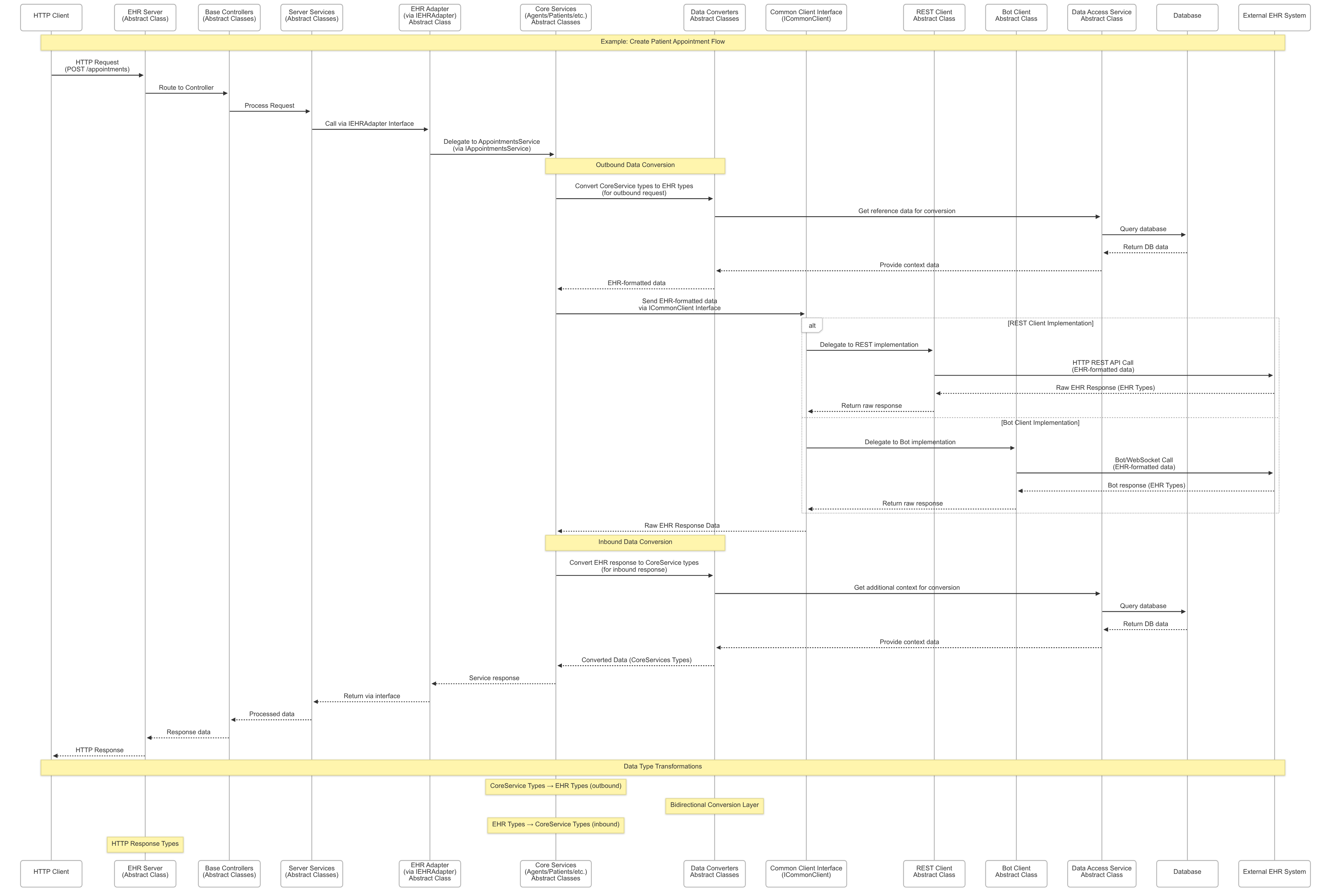
Outbound Request Flow (CoreService → EHR)
Step 1: HTTP Request Reception
Flow: Client sends HTTP request to EHRServer → Server routes to appropriate Controller → Controller delegates to ServerService
Key Activities:
- Request validation and authentication
- Route resolution and parameter extraction
- Security checks and authorization
- Request logging and monitoring
Step 2: Business Logic Processing
Flow: ServerService processes business logic → Calls EhrAdapter via IEhrAdapter interface → Adapter delegates to appropriate CoreService
Key Activities:
- Business rule validation
- Data sanitization and normalization
- Service selection and routing
- Context preparation for core services
Step 3: Data Preparation
Flow: CoreService receives business request → CoreService calls Converter for data transformation → Converter uses DataAccessService for context data if needed → Converter returns EHR-formatted data to CoreService
Key Activities:
- Data type conversion (CoreService → EHR format)
- Context data retrieval from database
- Data enrichment and validation
- Format-specific transformations
Step 4: EHR Communication
Flow: CoreService calls EHR via IEhrAdapterClient interface → Interface routes to appropriate client (REST/Bot) → Client sends EHR-formatted data to external EHR system
Key Activities:
- Client selection based on configuration
- Authentication and security token management
- Request transmission with retry logic
- Response handling and error management
Inbound Response Flow (EHR → CoreService)
Step 1: EHR Response Reception
Flow: Client receives raw response from EHR system → Client returns raw EHR data to CoreService
Key Activities:
- Response validation and error checking
- Response deserialization and parsing
- Basic response logging
- Connection health monitoring
Step 2: Data Conversion
Flow: CoreService calls Converter for response transformation → Converter uses DataAccessService for context data if needed → Converter returns CoreService-formatted data
Key Activities:
- Data type conversion (EHR → CoreService format)
- Context data enrichment
- Data validation and integrity checks
- Error handling for conversion failures
Step 3: Response Processing
Flow: CoreService processes converted data → Returns business response to Adapter → Adapter returns to ServerService → ServerService prepares HTTP response → Controller formats and sends HTTP response to client
Key Activities:
- Business logic application
- Response formatting and serialization
- HTTP status code determination
- Response logging and monitoring
Data Type Transformations
Transformation Pipeline:
- Input: CoreService Types → EHR Types (outbound)
- Processing: Bidirectional Conversion Layer with context enrichment
- Output: EHR Types → CoreService Types (inbound)
- Final: HTTP Response Types for client consumption
Data Flow Diagram
Interface Definitions
Core Interfaces
- IEhrServer
- IEhrAdapter
- IEhrAdapterClient
Service Interfaces
- IEhrAdapterAppointmentsService
- IEhrAdapterAgentsService
- IEhrAdapterPatientsService
- IEhrAdapterAvailabilityService
Converter Interfaces
IEhrAdapterEntityConverter
Design Patterns
1. Abstract Factory Pattern
Implementation: ClientsFactory creates appropriate client implementations based on configuration and runtime requirements.
Benefits:
- Flexible client instantiation with runtime configuration
- Support for multiple EHR system types
- Clean separation of client creation logic
2. Adapter Pattern
Implementation: EhrAdapter adapts various EHR systems to a common interface, abstracting system-specific details.
Benefits:
- Pluggable EHR system support
- Consistent API across different EHR implementations
- Easy integration of new EHR systems
- Isolation of EHR-specific logic
3. Strategy Pattern
Implementation: IEhrAdapterClient allows switching between REST/Bot communication strategies at runtime.
Benefits:
- Runtime client selection based on requirements
- Protocol flexibility (HTTP, WebSocket, etc.)
- Easy testing with different communication methods
- Performance optimization through client selection
4. Template Method Pattern
Implementation: Abstract classes define common behavior with customization points for concrete implementations.
Benefits:
- Code reuse across different implementations
- Consistent implementation patterns
- Easier maintenance and updates
- Enforced structure for implementations
5. Dependency Injection Pattern
Implementation: NestJS DI container manages all dependencies with interface-based injection.
Benefits:
- Loose coupling between components
- Configuration flexibility
- Runtime dependency resolution
6. Bridge Pattern
Implementation: Converters bridge between different data representations, abstracting transformation complexity.
Benefits:
- Abstraction from implementation details
- Flexible data transformation pipeline
- Support for multiple data formats
- Separation of conversion logic
7. Observer Pattern
Implementation: Event-driven architecture for system notifications and monitoring.
Benefits:
- Loose coupling between components
- Real-time system monitoring
- Event-driven processing
- Scalable notification system
8. Command Pattern
Implementation: Request encapsulation for EHR operations with support for queuing and retry logic.
Benefits:
- Operation queuing and batching
- Retry and rollback support
- Request logging and auditing
- Asynchronous processing
Implementation Guidelines
Abstract Class Implementation Standards
Core Requirements
- All components must extend their respective abstract classes
- Abstract classes define common behavior and required method signatures
- Concrete implementations provide EHR-specific logic
- Use protected methods for shared functionality between implementations
Interface Adherence Standards
- All services must implement their corresponding interfaces
- Interfaces define public contracts for component interaction
- Maintain backward compatibility when evolving interfaces
Data Conversion Rules
Critical Requirements
- Bidirectional Support: All converters must support both directions (to/from EHR)
- Context Awareness: Use DataAccess service for enrichment data
- Type Safety: Maintain strong typing throughout conversion pipeline
- Error Handling: Implement proper error handling for conversion failures
- Validation: Validate data integrity before and after conversion
- Performance: Cache frequently used conversion mappings
Client Implementation Standards
Common Interface Requirements
- All clients must implement IEhrAdapterClient to ensure consistent behavior
- Support for authentication and authorization
- Comprehensive error handling and retry logic
- Connection health monitoring and recovery
Error Handling Requirements
- Implement consistent error handling across all clients
- Use exponential backoff for retry logic
- Handle network failures gracefully
- Log all errors with appropriate context
Authentication Standards
- Support multiple authentication methods (OAuth, API Key, Basic Auth)
- Handle token refresh automatically
- Secure credential storage and management
- Authentication failure recovery
Performance Considerations
Caching Strategy
Implementation: Cache frequently accessed conversion data and reference information
- In-memory application cache for hot data
- Redis cache for shared data across instances
- TTL-based expiration for time-sensitive data
Input Validation and Sanitization
SQL Injection Prevention
- Use parameterized queries exclusively
- Input sanitization and validation
- Context-based queries should be preferred
Environment-Specific Configuration
- Separate secrets for each environment
- Configuration validation on startup
- Secure configuration distribution
- Configuration change auditing
Monitoring and Observability - TODO
Deployment and Operations - TODO
Database Management - TODO
Conclusion
This comprehensive design specification provides a blueprint on the implementation of the EHR Integration System. Regular reviews and updates would be conducted to ensure the specification remains current with evolving requirements and best practices.
This document serves as the comprehensive design specification for the EHR Integration System. It should be used as the primary reference for implementation, testing, and maintenance activities.